


A leveraged forex position can be closed even when the trader never presses the sell button. When account equity falls too far relative to the margin required to keep leveraged positions open, the broker can begin liquidating trades automatically. The point at which this happens is commonly called the forex broker stop out level.
Understanding it is essential because a stop-out is not simply another warning. Once the account reaches the broker’s liquidation threshold, the trading platform can start closing positions without waiting for the trader’s approval. In fast markets, the process can happen quickly.
The exact calculation varies between brokers, platforms and regulatory jurisdictions. A forex stop out level of 50% at one broker may also be displayed differently from another broker’s margin metric, so traders should understand the formula behind the percentage rather than relying on the number alone.
What Is a Forex Broker Stop Out Level?
A forex broker stop out level is the margin threshold at which a broker begins automatically closing one or more leveraged positions because the account no longer has sufficient equity to support them.
Leveraged trading requires margin. Instead of paying the full notional value of a position, the trader provides a smaller amount of capital as collateral. As unrealised losses increase, account equity falls. Eventually, the remaining equity may approach the minimum amount required by the broker. That is where broker stop out rules become important.
For UK retail CFD accounts, the Financial Conduct Authority’s CFD rules require firms to close positions when account funds fall to 50% of the margin required to maintain open positions.
European measures established by ESMA similarly introduced an account-level margin close-out rule at 50% of minimum required margin for retail CFD clients.
These regulatory rules should not be interpreted as a worldwide standard. Offshore brokers, institutional accounts and accounts operating under other jurisdictions can use different thresholds.
How Forex Margin Stop Out Works
A forex margin stop out occurs because the account’s equity has fallen relative to the margin being used. Equity generally reflects the account balance plus or minus unrealised trading profits and losses. Used margin is the capital currently committed to supporting leveraged positions.
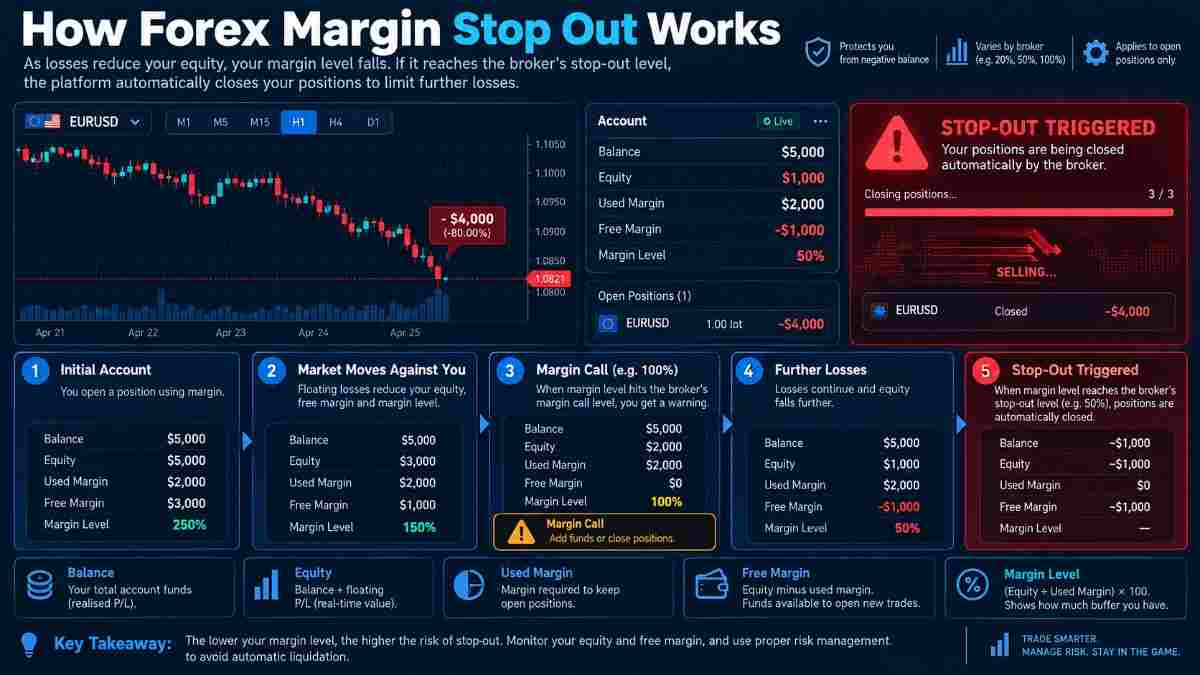

Consider a simplified example.
A trader has $5,000 in account equity and has positions requiring $2,000 of margin. If losses reduce equity to $1,000, equity is now equal to 50% of the required $2,000 margin.
Under a 50% account-level close-out rule, the account has reached the liquidation threshold.
The broker may then close one or more positions to reduce the margin requirement.
The precise stop out percentage forex calculation can differ by platform. Some systems display a conventional margin-level percentage, while others use their own margin-closeout indicator.
OANDA provides a useful example. Its U.S. platform explains that its own Margin Closeout Percentage reaches 100% when equity has fallen to half of the required margin, triggering automatic close-out. The same economic relationship may therefore appear under a differently labelled platform percentage. OANDA margin calculations
This is why traders should read the broker’s calculation method rather than assuming every 50% or 100% figure means the same thing.
Stop Out vs Margin Call: What Is the Difference?
The distinction between stop out vs margin call is one of the most important concepts in leveraged trading.
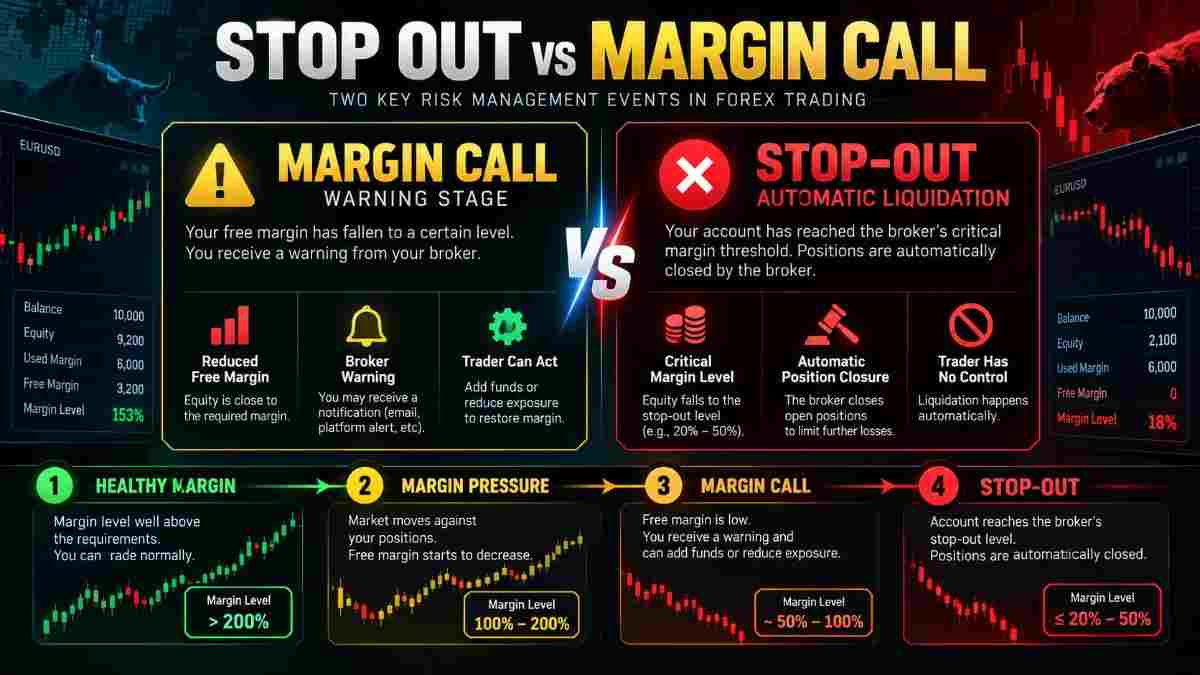
A margin call is generally a warning that the account’s margin position has deteriorated. A stop-out is the point where the broker can begin automatically closing positions.
In practical terms:
| Stage | What Usually Happens |
| Healthy margin | Equity remains comfortably above minimum margin requirements |
| Margin pressure | Losses reduce free margin and available trading capacity |
| Margin call | Broker or platform warns that additional margin may be needed |
| Stop-out | Broker automatically closes positions under its liquidation rules |
A forex broker margin call does not necessarily mean the account will be closed immediately. Depending on the broker, the trader may still have time to reduce exposure, close positions manually or add funds.
However, traders should never assume that a warning will always arrive in time.
OANDA specifically cautions that in fast-moving markets there can be little or no time between a margin warning and margin closeout. OANDA margin terminology
This is why stop out vs margin call should be understood as warning versus automatic risk-control action, not as two interchangeable terms.
Why Brokers Use Automatic Stop-Out Rules
A broker stop out mechanism exists because leveraged losses can develop faster than they would in an unleveraged investment. Suppose a trader controls $30,000 of currency exposure with a much smaller margin deposit. A relatively modest adverse price movement can represent a significant percentage of the capital held in the account.
The broker therefore monitors whether sufficient equity remains to support the position. Automatic liquidation is designed to prevent an account from continuing indefinitely with inadequate margin. It also works alongside other safeguards, such as leverage limits and negative balance protection where those protections are legally required.
The FCA’s retail CFD framework combines leverage limits with a 50% margin close-out requirement and protection against losing more than the total funds in the relevant trading account.
For traders comparing broker conditions, TopLegitBrokers’ Capitalix review and SmartSTP review provide examples of why leverage and margin terms should be examined alongside other account conditions.
Forex Stop Out Level Can Differ Between Brokers
There is no universal forex stop out level applicable to every retail forex account worldwide. One broker may begin liquidation at 50% of required margin. Another entity operating under different regulation may use 20%, 30% or another threshold. A broker can also choose stricter controls than the regulatory minimum.
The FCA confirmed when establishing its permanent CFD rules that the 50% level acts as a minimum protection and does not prevent firms from closing positions earlier—for example, at a higher percentage of required margin.
This is important when comparing brokers advertising high leverage.
Higher leverage means less initial margin is required for the same market exposure, but that does not make the exposure itself smaller. Account equity can still deteriorate quickly when the market moves against a large leveraged position.
TopLegitBrokers’ GTC FX review illustrates why maximum leverage figures should be considered together with margin and risk-management conditions rather than in isolation.
What Does Stop Out Percentage Forex Mean?
The stop out percentage forex platforms display normally represents the point at which available equity has fallen too close to required margin.
But the underlying formula matters.
Many platforms use a margin-level concept based broadly on:
Equity ÷ Used Margin × 100
Using that approach, if equity is $1,000 and used margin is $2,000, the margin level is 50%.
Other platforms present their close-out metric differently. As noted earlier, OANDA’s U.S. system can display a 100% Margin Closeout Percentage at the economic point where equity equals 50% of required margin.
So when evaluating a forex broker stop out level, traders should identify three things: how the platform calculates the percentage, what threshold activates a warning and what threshold causes liquidation.
Without that context, comparing raw percentages can be misleading.
What Is a Forex Liquidation Level?
A forex liquidation level is effectively the point where the broker’s margin rules permit or require automatic position closure. Liquidation does not necessarily mean every position disappears simultaneously.
Some brokers close the largest losing position first. Others may close the position consuming the most margin. Certain systems close all open trades once the threshold is reached.
OANDA, for example, states that under its relevant U.S. account rules, all tradable open positions are automatically closed when margin closeout occurs. Before trading, check the broker’s liquidation policy and understand how the forex broker stop out level is applied. Two brokers with the same stop-out percentage can still produce different results because they may choose different positions to liquidate. Comparing the forex broker stop out level across platforms can help traders understand how margin risks are managed. When researching the forex broker stop out level, review the broker’s margin requirements and liquidation procedures. A clear understanding of the forex broker stop out level can help traders plan position sizes and manage available margin. Always verify the specific forex broker stop out level and related rules in the broker’s official documentation before opening a trade.
Can a Stop-Loss Prevent a Forex Margin Stop Out?
A stop-loss can help control position-level risk, but it does not guarantee that an account will never reach a forex margin stop out. Markets can gap through stop prices. Slippage can occur during volatile periods, and several positions can lose simultaneously. A trader may also place a stop-loss far enough away that the overall account reaches the liquidation threshold first.
ESMA has specifically clarified that account-level margin close-out requirements can cause a position with a guaranteed stop to be closed before that stop level is reached if the account reaches the regulatory close-out threshold first. Margin management therefore needs to operate at account level, not just trade level.
How to Reduce the Risk of Broker Stop Out
The most effective way to reduce broker stop out risk is to control leverage before the account comes under pressure. Smaller positions require less margin and usually leave more free equity available to absorb normal price fluctuations.

Traders should also monitor correlated positions. Holding several trades that appear separate can produce concentrated exposure. EUR/USD long, GBP/USD long and USD/CHF short, for example, can all create meaningful exposure to a weaker U.S. dollar.
Depositing more money can increase available margin, but constantly adding funds to defend losing trades is not a substitute for risk management.
A better approach is to decide the acceptable loss before entering and size the trade accordingly. TopLegitBrokers’ Airmarkets review also highlights the importance of reviewing leverage, margin requirements and stop-out terms for the specific contracts being traded.
How to Check a Broker Liquidation Policy
A broker liquidation policy should be available in the broker’s margin policy, risk disclosure or trading conditions. Before opening leveraged positions, check the forex broker stop out level, margin-call threshold, method used to calculate equity and margin, liquidation sequence, and whether the rules operate per position or across the account. Also verify the legal entity holding the account. Comparing the forex broker stop out level across brokers can help you understand how each platform manages margin risk. When reviewing the forex broker stop out level, check whether positions are closed automatically once equity falls below the required threshold. Understanding the forex broker stop out level can help you plan position sizes and manage available margin more carefully. Always confirm the exact forex broker stop out level in the broker’s official documentation before trading.
The same international broker can operate through several regulated companies, and margin conditions may differ between them. A UK retail account, offshore account and professional account should not automatically be assumed to have identical protections.
Final Thoughts on Forex Broker Stop Out Level
A forex broker stop out level is the line at which margin management stops being entirely the trader’s decision. Before that point, the trader can reduce exposure, close positions or add capital. Once the stop-out conditions are met, the broker’s automated liquidation process can take over.
The crucial lesson is not simply to memorise a percentage. Traders should understand how their broker calculates margin, when a forex broker margin call appears, what causes automatic liquidation and which positions will be closed first.
A stop-out mechanism can limit further deterioration, but reaching it usually means the account was already carrying significant leveraged losses.
Managing position size and free margin well before the forex broker stop out level is reached is considerably more useful than trying to rescue an account after automatic liquidation has begun.
Disclosure
This article is for educational and informational purposes only. It is not financial, investment, legal, tax, or trading advice. Forex and CFD trading involves substantial risk, particularly when leverage is used, and can result in loss of capital. Always verify margin requirements and account protections directly with the broker before trading.
FAQs
What is a forex broker stop out level?
A forex broker stop out level is the margin threshold at which the broker can begin automatically closing leveraged positions because account equity is no longer sufficient to support them.
What is the difference between stop out vs margin call?
In stop out vs margin call, a margin call is generally a warning about insufficient margin, while a stop-out triggers automatic position liquidation under the broker’s rules.
Is the forex stop out level always 50%?
No. A forex stop out level depends on the broker, account and jurisdiction. FCA-regulated retail CFD accounts are subject to an account-level 50% margin close-out requirement, but other jurisdictions can differ.
What happens during forex margin stop out?
During a forex margin stop out, the broker automatically closes one or more positions to reduce the account’s required margin.
What is stop out percentage forex?
The stop out percentage forex figure represents the broker’s threshold for automatic liquidation. Its exact calculation should be checked because platforms can display margin metrics differently.
What is a forex liquidation level?
A forex liquidation level is the point at which margin conditions permit or require the broker to close positions automatically.
Can I lose more money after a broker stop out?
It can depend on regulation, market gaps and account protections. Some retail CFD regimes include negative balance protection, but traders should verify the rules applying to their exact broker entity and account.