


Introduction
Embarking on your investment journey raises many pivotal questions: Which platform offers the right balance of ease, cost, and educational resources? But is Fidelity a good choice for beginner investors? In this comprehensive guide, we’ll examine Fidelity’s strengths and weaknesses compared to alternative brokers such as Capitalix, FXRoad, TradeEu Global, Smart STP, and Titan Edge and help you decide if it’s the right home for your first investment.

Fidelity at a Glance
Founded in 1946, Fidelity Investments has grown into a Fortune 500 behemoth offering:
- Brokerage Accounts: Stocks, ETFs, mutual funds, bonds, options
- Retirement Accounts: IRAs, 401(k) rollovers, Roth IRAs
- Cash Management: Cash sweeps, no-fee ATM cards
- Research & Education: In-depth market analysis, webinars, guided portfolios
With over $10 trillion in assets under management, Fidelity combines institutional-grade tools with a consumer-friendly interface.
Account Types & Minimum Deposits
Brokerage Accounts
- Individual & Joint Brokerage: $0 minimum to open; buy fractional shares from $1.
- Prosperity Plan (Robo-Advisory): Managed portfolios with a $10,000 minimum; advisory fee of 0.35%.
Retirement Accounts
- Traditional & Roth IRAs: No minimum initial deposit; zero commission on stocks and ETFs.
- 401(k) Rollovers: No fees to transfer an existing retirement plan.
Comparison:
- Capitalix/FXRoad/TradeEu Global/Smart STP/Titan Edge typically require $250–$2,000 to open CFD or forex accounts, making Fidelity’s zero-min approach highly accessible for buy-and-hold investors.
Fees & Commissions
Trades on Fidelity
- Stocks & ETFs: $0 commission per trade.
- Options: $0.65 per contract (no base fee).
- Mutual Funds: Over 4,000 no-transaction-fee funds; $49.95 for others.
- Bonds: Online U.S. Treasury trades are free; other bond trades carry small markups.
Cash Management & Other Fees
- ATM Fees: $0 on Fidelity’s All-In-One line; foreign ATM fee rebates.
- Account Fees: No maintenance or inactivity fees.
Comparison:
- TradeEu Global/Smart STP offer zero-commission CFDs but slightly wider spreads.
- Capitalix charges raw spreads plus commissions, suited for active traders but overkill for buy-and-hold beginners.
- Fidelity’s fee structure is simple and predictable ideal for new investors.
Platform Usability
Web & Mobile Apps
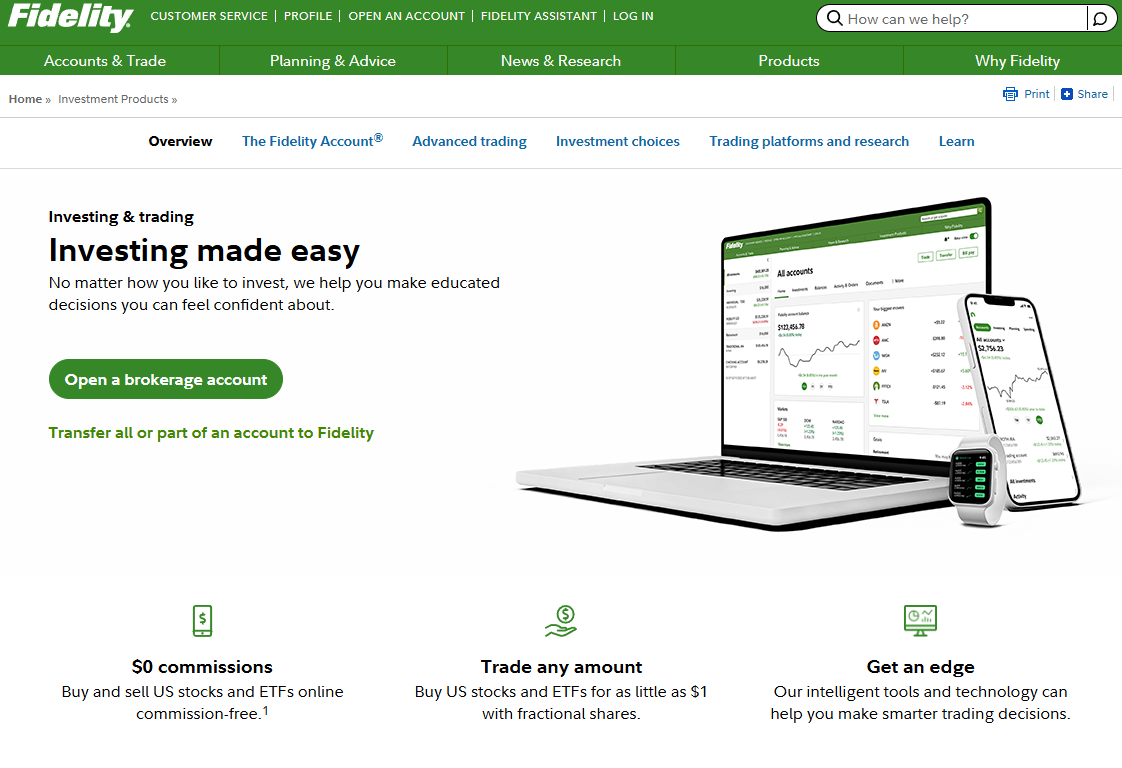
- Fidelity.com: Clean dashboards, drag-and-drop watchlists, intuitive trade tickets.
- Mobile App: Real-time quotes, two-step order entry, fingerprint/Face ID login.
Advanced Tools (for later stages)
- Active Trader Pro: Downloadable desktop platform with Level II quotes and charting no extra fee once you execute 36 trades/year.
- StreetBeat News Feed & Ideas: Curated daily analysis for stocks, ETFs, and funds.
Comparison:
- Forex/CFD platforms like MetaTrader (used by Capitalix, FXRoad) focus on order-book depth and algorithmic trading, which can overwhelm beginners.
- Fidelity’s web and mobile interfaces prioritize simplicity with optional advanced layers, easing beginners into investing.

Research, Education & Support
Learning Center
- Webinars & Videos: Intro to stocks, ETFs, options basics, retirement planning.
- Guided Portfolios: Model allocations based on risk tolerance.
Research Reports
- Morningstar Integration: Ratings and analysis for thousands of mutual funds and ETFs.
- Third-Party Research: From CFRA, Ned Davis, and others free for clients.
Customer Service
- 24/7 Phone Support: Fidelity Investments phone number connects you to human advisors.
- In-Branch Assistance: Over 200 Investor Centers nationwide.
Comparison:
- Prosperi Academy focuses on trading strategies but lacks Fidelity’s full spectrum of retirement and passive-management education.
- TradeEu Global offers live chat for CFD queries, but it doesn’t match Fidelity’s broad investor services.
Fractional Shares & Dollar-Cost Averaging
Fractional Shares:
- Buy partial shares of high-priced stocks Amazon, Google starting at $1.
- Enables diversified portfolios without large capital.
Automatic Investing:
- Set up recurring purchases of stocks, ETFs, or mutual funds with as little as $1 per trade.
- Dollar-cost averaging smooths out market volatility a powerful tool for beginners.
Comparison:
- Forex/CFD brokers do not offer fractional shares or automated purchases; they cater to high-frequency or leveraged strategies.
- Fidelity’s fractional and auto-invest features encourage disciplined, long-term investing habits.
Safety, Regulation & Fund Security
Regulatory Oversight:
- Registered with SEC, FINRA, and SIPC member protects up to $500,000 in securities and cash (including $250,000 cash).
- Regular FINRA audits and compliance reporting.
Data Security:
- Multi-factor authentication, 256-bit encryption, and biometric logins.
Comparison:
- Offshore CFD brokers (e.g., some using MetaTrader) often lack SIPC equivalent protection and may operate under less rigorous regulators.
- Fidelity’s tier-1 regulation and SIPC coverage provide superior safety for beginners.
Transitioning to Active Trading
For investors who outgrow basic brokerage:
- Options Trading: Single-leg and multi-leg strategies, with educational walkthroughs.
- Margin & Shorting: Advanced features via TS Select.
- API & Algo Trading: Fidelity’s WealthLab Pro integration for custom strategies.
Comparison:
- Brokers like FXRoad and Capitalix excel at algorithmic, high-leverage forex/CFD trading, but carry higher risk and complexity.
- Fidelity provides an intermediate path starting with passive portfolios, scaling up to options and APIs when you’re ready.
Conclusion
For beginner investors seeking a safe, cost-effective, and user-friendly platform, Fidelity Investment stands out. With zero-minimum deposits for U.S. brokerage and IRA accounts, commission-free stock/ETF trades, robust research tools, and SIPC protection, Fidelity offers a low barrier to entry and a clear growth path from fractional-share buys to advanced options and algorithmic trading. While specialized brokers like Capitalix, FXRoad, TradeEu Global, Smart STP, and Titan Edge deliver powerful features for active Forex and CFD traders, Fidelity’s well-rounded ecosystem makes it an excellent first choice for those new to investing.
FAQs
1.Why does Fidelity require no minimum deposit for U.S. brokerage accounts?
To lower barriers for new investors, Fidelity allows you to open a standard brokerage or IRA account with $0, encouraging participation regardless of initial capital.
2.Is it safe to keep my funds at Fidelity compared to offshore brokers?
Yes Fidelity is SEC- and FINRA-regulated, SIPC-insured up to $500,000, and employs industry-leading security measures, unlike many offshore trading platforms.
3.How can I start buying fractional shares with Fidelity?
In your brokerage account, search for the stock or ETF you want, enter an amount (e.g., $5), and Grace orders the corresponding fraction no whole-share requirement.
4.Do I need an ADVANCED account to access research and education?
No Fidelity’s basic brokerage accounts include full access to webinars, articles, and third-party research like Morningstar, free of charge.
5.How do I compare Fidelity’s fees to those of CFD brokers like Capitalix?
Fidelity charges $0 commissions on stocks/ETFs and $0.65 per options contract, while CFD brokers may advertise zero spreads but recoup via higher overnight and financing fees making Fidelity often cheaper for buy-and-hold.