


A leveraged Forex position can lose money faster than the cash originally required to open it. During normal market conditions, margin close-out systems may liquidate positions before the account falls below zero. During a severe gap or sudden loss of liquidity, however, the next available execution price can be much worse than expected.
This is where negative balance protection Forex rules become important. When the protection applies, a retail client’s liability on the protected trading account is limited so that trading losses cannot create a debt beyond the funds covered by the rule.
The important qualification is that forex negative balance protection is not universal. Whether it applies depends on the product, regulatory jurisdiction, client classification and legal entity holding the account.
A retail CFD trader under an FCA-regulated UK entity may therefore have different protection from a professional client or somebody trading through an offshore entity of the same international broker.
What Is Negative Balance Protection in Forex?
The negative balance protection meaning is relatively straightforward: if applicable trading losses drive an account below zero, the broker cannot require the protected retail client to repay that negative trading balance beyond the funds covered by the regulation.
The FCA’s current CFD rules state that a retail client’s liability for restricted speculative investments connected to the account is limited to the funds in that account. Those rules cover CFDs and include rolling spot foreign exchange.
European CFD protections use the same general account-level principle. ESMA explains that a retail client’s aggregate liability for CFDs connected to the trading account must be limited to the funds specifically dedicated to CFD trading.
You can review the current UK rules directly in the FCA Handbook.
Can You Lose More Than Your Forex Deposit?
The answer to can you lose more than your forex deposit is: it depends on the account.
For a qualifying UK or EU retail CFD account with mandatory negative balance protection, trading losses covered by that protection should not create a liability greater than the funds in the relevant CFD trading account.
For accounts without that protection, the situation can be different. A severe market gap could theoretically cause the closing price to move far beyond the level where the broker expected to liquidate the position.
Professional accounts, institutional arrangements and offshore entities may not provide the same protection.
This is why the correct question is not simply whether the brand advertises forex account protection, but whether the specific legal entity and account classification provide it.
How a Forex Account Can Become Negative
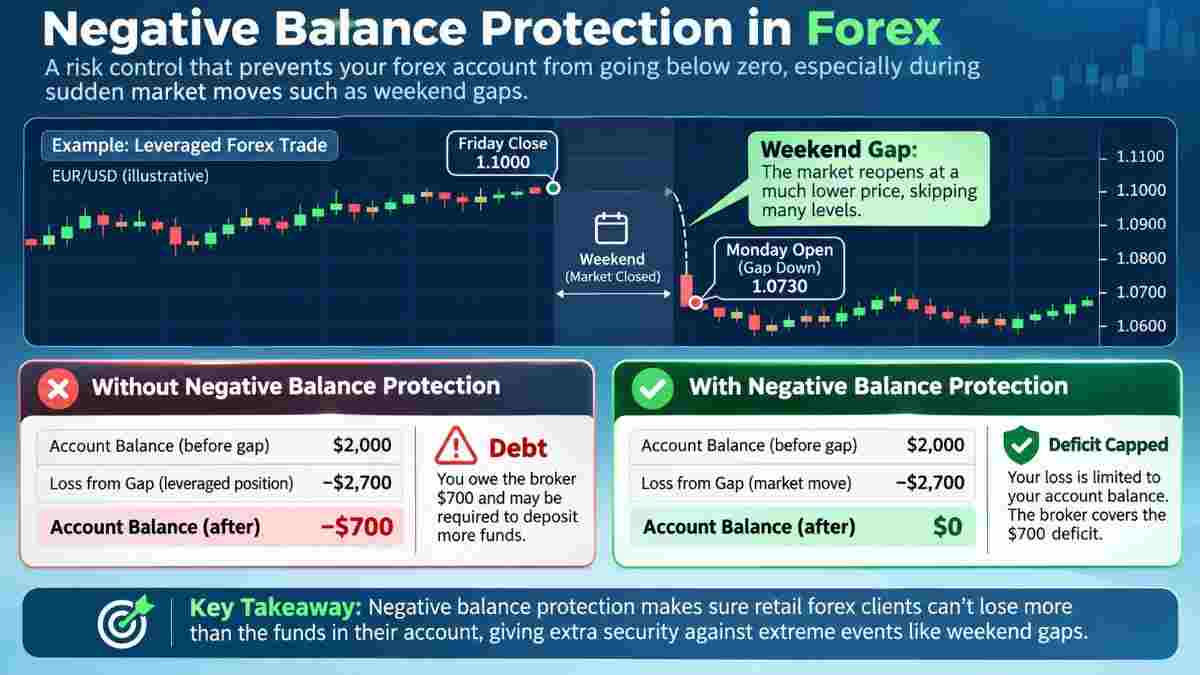
Imagine a trader has $2,000 in a leveraged account and holds a large position over the weekend.
A major unexpected event occurs while the market is closed. When trading resumes, the currency pair gaps sharply against the position.
The trader placed a stop loss that would theoretically have limited the loss to $1,500. However, there were no executable prices near the stop level, so the order was filled much farther away.
Instead of losing $1,500, the position generates a $2,700 loss.
The account would mathematically show:
Starting balance: $2,000
Trading loss: $2,700
Calculated balance: -$700
Where valid forex negative balance protection applies, the protected client should not normally be required to pay that $700 trading deficit.
Without such protection, the contractual outcome may be different.
Why Stop-Out Protection Does Not Always Prevent a Negative Balance
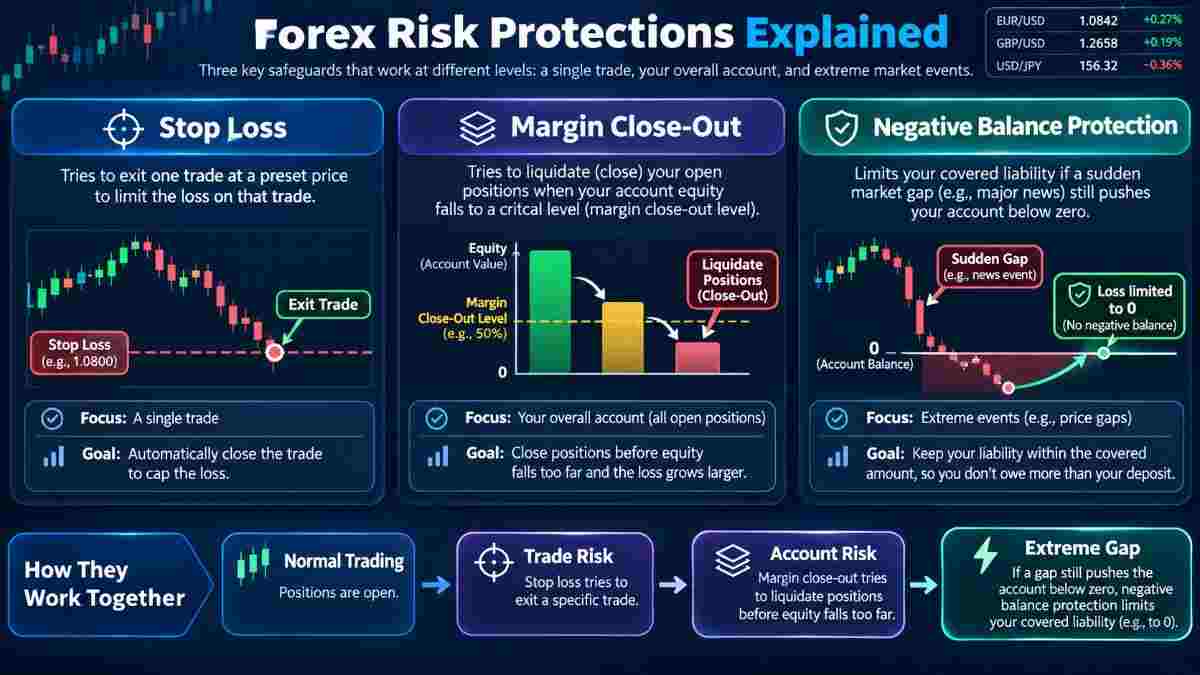
A stop-out system and negative balance protection Forex are related but separate forms of broker risk protection.
The stop-out mechanism attempts to close positions before account equity deteriorates too far. Negative balance protection deals with what happens if those liquidation systems cannot prevent the account from becoming negative.
For example, UK and European retail CFD frameworks combine an account-level margin close-out rule with negative balance protection.
During ordinary market movements, automatic liquidation may work before the balance becomes negative. During a sudden gap, however, the broker may only be able to close the position at the next available market price.
That is why negative balance protection remains relevant even when a broker already uses automated stop-out systems.
For a detailed explanation of liquidation thresholds, see Forex Broker Stop-Out Levels Explained.
Negative Balance Protection Explained With a Market Gap
Consider another simplified example.
A trader has:
| Account item | Amount |
| Account funds | $5,000 |
| Open leveraged exposure | $100,000 |
| Planned maximum loss | $4,000 |
| Actual loss after market gap | $6,500 |
| Theoretical account balance | -$1,500 |
Without protection, the contractual terms could potentially leave the client owing $1,500.
Where mandatory negative balance protection explained under a qualifying retail CFD framework applies, the broker’s recourse is limited according to the relevant rules.
The protection does not mean the original $5,000 is returned. The client can still lose all the money dedicated to the protected trading account.
It protects against an additional trading debt, not against losing the deposited capital itself.
Negative Balance Protection Is Not a Refund Policy
This is one of the most important distinctions in understanding the negative balance protection meaning.

Suppose a trader deposits $10,000 and loses all $10,000 through normal trading. Negative balance protection does not restore that money.
If the account then temporarily calculated a further $2,000 deficit because of a market gap, the protection may prevent the broker from collecting that additional deficit where the relevant rules apply.
Therefore:
Negative balance protection: may prevent covered trading losses from creating additional debt.
Capital protection: would imply protection of the original investment, which Forex and CFD trading generally does not provide.
The two concepts should never be confused.
Where Is Forex Negative Balance Protection Mandatory?
The regulatory position differs by jurisdiction.
United Kingdom
The FCA requires account-level negative balance protection for retail clients trading restricted speculative investments such as CFDs and rolling spot FX.
The protection limits the retail client’s liability to the funds specifically dedicated to the relevant account.
European Union
European national CFD measures continue to include negative balance protection for retail clients. ESMA reiterated in February 2026 that products falling within the CFD measures remain subject to protections including leverage limits, margin close-out and negative balance protection.
Australia
Australia’s retail CFD product intervention framework also includes negative balance protection. ASIC’s current CFD intervention order remains in effect and limits retail CFD losses to funds covered by the relevant trading account rules.
ASIC was consulting in late 2026 on extending and updating those protections beyond the current scheduled expiry framework.
Other jurisdictions
Rules outside these markets can differ substantially. An offshore regulator may require a particular form of forex broker negative balance policy, leave it to the broker’s contract or provide no equivalent mandatory protection.
Never assume that UK, EU or Australian rules automatically apply to an international account.
Professional Clients May Lose Negative Balance Protection
Client classification matters.
The FCA has specifically warned consumers about giving up retail protections when firms encourage them to become professional clients. Higher leverage may appear attractive, but professional classification can remove protections that apply automatically to retail customers.
A professional trader should therefore check the broker agreement carefully before assuming the account contains the same forex account protection as a retail account.
The same principle applies when a trader voluntarily opens an account under an offshore entity to obtain higher leverage.
More leverage and fewer restrictions can also mean fewer regulatory safeguards.

What Should a Forex Broker Negative Balance Policy Say?
A clear forex broker negative balance policy should explain:
- Which customers receive protection.
- Which products are covered.
- Whether protection applies per account or per position.
- What happens after an account becomes negative.
- Whether the broker automatically resets a protected deficit.
- Whether professional clients are excluded.
- Whether abuse, fraud or prohibited trading practices create contractual exceptions.
The policy should appear in the broker’s client agreement, terms or risk disclosures.
Do not rely only on a sentence in a promotional FAQ.
If the broker operates several entities, verify that the policy belongs to the exact company named in your account agreement.
Can a Broker Voluntarily Offer Negative Balance Protection?
Yes. A broker may provide contractual broker risk protection even when the local regulator does not require it.
However, contractual protection should be read carefully. A voluntary policy may contain conditions that are different from statutory or regulatory protection.
The broker may also change its terms subject to the procedures allowed under the contract.
For this reason, a voluntary statement should not automatically be treated as equivalent to FCA, EU or ASIC retail CFD protection.
Regulatory status and contractual protection should be checked separately.
Does Negative Balance Protection Cover All Accounts at the Broker?
Not necessarily.
ESMA’s account-level framework limits liability in relation to funds specifically connected with the protected CFD trading account. Funds held for unrelated purposes are not automatically treated in the same way.
A broker may also operate separate wallets, securities accounts or trading subaccounts.
Therefore, negative balance protection Forex should not be interpreted as a blanket guarantee over every financial relationship with the broker.
Read the account structure and identify exactly what the policy covers.
Does Negative Balance Protection Protect Against Broker Failure?
No. This is another common misunderstanding.
Negative balance protection concerns trading losses that push the protected account below zero. It is not the same as client-money segregation, an investor compensation scheme or insolvency protection.
If a broker becomes insolvent, different rules determine what happens to client money.
If a broker is fraudulent, the problem is different again.
A complete assessment of forex account protection should therefore examine regulatory status, client-money rules, complaint mechanisms and any applicable compensation arrangements in addition to negative balance protection.
What About Stop Losses?
A stop loss can reduce trading risk, but it does not make forex negative balance protection unnecessary.
An ordinary stop becomes a market order once triggered and may be executed at the next available price. During severe gaps, that can be substantially different from the requested stop level.
Even guaranteed stops have to be considered together with account-level margin rules.
ESMA has previously clarified that margin close-out requirements can result in a position being liquidated before a guaranteed-stop level in certain account circumstances.
Risk management therefore operates at both trade and account level.
How to Check Your Broker’s Protection Before Depositing
Before relying on a broker’s negative balance protection Forex statement, identify the legal company that will hold your account.
Then find that entity on the regulator’s official register. Confirm that the website domain matches and that the firm has permission to provide the relevant service.
Next, read the client agreement and search for terms such as:
- negative balance;
- limitation of liability;
- margin close-out;
- client classification;
- retail client;
- professional client;
- deficit;
- recourse.
If the broker does not clearly explain what happens after a negative account balance, ask for the policy in writing before funding the account.
Negative Balance Protection vs Margin Close-Out
These protections solve different problems.
| Protection | Primary purpose |
| Margin close-out | Attempts to close positions before losses consume too much account equity |
| Negative balance protection | Limits covered liability if losses nevertheless push the account below zero |
| Stop loss | Attempts to close one position at a trader-defined level |
| Client-money protection | Concerns handling of client funds by the broker |
| Compensation scheme | May apply in certain cases when an eligible regulated firm fails |
A strong forex account protection framework may contain several of these elements.
None removes the basic market risk of losing trading capital.
Can You Still Lose Your Entire Forex Account?
Yes.
Negative balance protection Forex does not guarantee that a trading account will retain part of its original balance.
If a retail trader deposits $5,000, the protection may limit the covered liability to those funds, but the trader can still lose the whole $5,000.
This is why descriptions such as “your money is protected” can be misleading when they fail to explain what protection actually means.
The more precise statement is that qualifying clients may be protected from owing additional money because of covered trading losses beyond the protected account funds.
Final Thoughts
Negative balance protection Forex is an important safeguard for leveraged trading, but it has a specific purpose. It limits covered account liability; it does not prevent losses, guarantee stop execution or protect the original deposit from ordinary trading losses.
UK and EU retail CFD rules provide account-level negative balance protection, and Australia’s current retail CFD framework provides a similar safeguard. Other jurisdictions and account classifications can differ.
The safest approach is to check the exact entity, client classification and forex broker negative balance policy before depositing.
If you are comparing brokers, treat negative balance protection as one part of a broader risk review rather than proof that an account is safe.
Disclosure
This article is for educational and informational purposes only. It is not financial, investment, legal, tax or trading advice. Forex and CFDs are leveraged products and can result in substantial losses. Regulatory protections depend on jurisdiction, client classification and the legal entity providing the account. Always check the broker’s current official documents before trading.
FAQs
What is negative balance protection in Forex?
It is a protection that can limit a qualifying client’s trading liability so that covered losses do not create a debt beyond the funds in the protected trading account.
Can you lose more than your Forex deposit?
Under qualifying UK/EU retail CFD protections, liability is limited at account level. Other accounts, jurisdictions or professional-client arrangements may have different rules.
Does negative balance protection refund trading losses?
No. It can protect against an additional negative balance but does not reimburse normal losses from the money already deposited.
Does every Forex broker offer negative balance protection?
No. Forex negative balance protection depends on regulation, entity, account and contractual terms.
What is the difference between stop-out and negative balance protection?
Stop-out attempts to liquidate positions before losses go too far. Negative balance protection addresses the remaining liability if the account still falls below zero.
Do professional Forex traders receive negative balance protection?
Not automatically. Professional classifications may lose retail protections, depending on the jurisdiction and broker agreement.
Does negative balance protection cover broker insolvency?
No. Insolvency and client-money protection are separate issues governed by different rules and compensation arrangements.